Why Your Instagram Engagement Isn't Converting
You're posting consistently. Your Reels get thousands of views. The comments are flowing in — "How much is this?", "Do you ship internationally?", "I need this!".
And yet, your Shopify revenue from Instagram is disappointingly low.
The problem isn't your content. It's the conversion architecture. The classic Instagram funnel asks users to leave a comment, find the link in bio, navigate a homepage, search for the product, select a variant, and go through checkout. That is five to seven friction steps from a moment of peak buying intent.
According to Baymard Institute, 70% of shoppers abandon their cart. More brutally, most don't make it that far — they never click the link in bio at all. The comment-to-DM funnel solves this at the root.
📊 Instagram DMs have a 90% open rate vs. 22% for email — making them the most powerful channel for instant conversion.
What Is a Comment-to-DM Funnel?
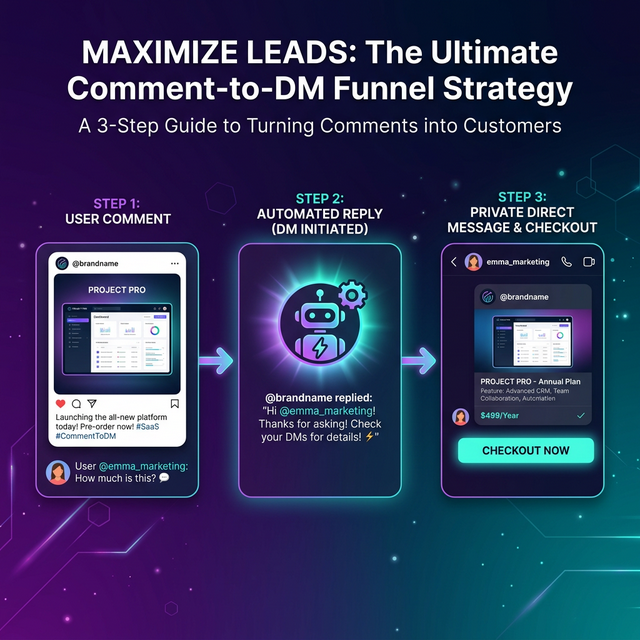
A comment-to-DM funnel is a 3-step automated sequence that captures buying intent the moment it appears in your comment section and moves the shopper toward checkout before they scroll away.
Step 1 — Comment Trigger. A user leaves a comment on your post. This can be a keyword-matched comment ("price", "how much", "link") or literally any comment on a target post.
Step 2 — Public Reply. Your brand account instantly replies publicly, confirming the product and letting them know a DM is on the way. This public reply also increases your post's engagement score, which Meta's algorithm rewards with broader distribution.
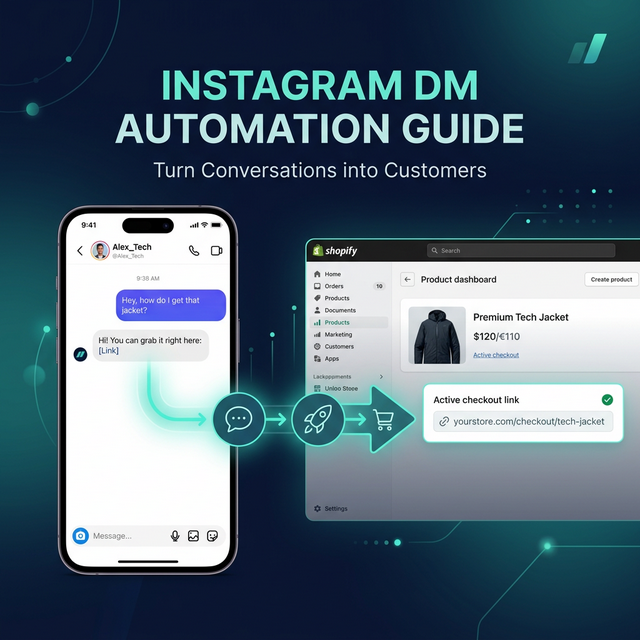
Step 3 — Private DM with Checkout Link. Within seconds, the user receives a personalized DM containing the exact product they asked about, the price, and a direct Shopify checkout link — optionally with a variant pre-selected or a discount pre-applied.
The entire sequence happens inside Instagram, without the user ever leaving the app.

Anatomy of a High-Converting DM
Not all DMs convert equally. Here's what separates a DM that drives sales from one that gets ignored:
Personalization. Reference the specific product they asked about by name. A generic "check out our store" DM will be ignored. "Hey! You asked about the Hydration Set — here's the link directly to that product" feels personal and relevant.
Immediate value. Deliver something useful: the exact product link, a discount code, or an answer to their question. The DM must justify opening.
A single, clear CTA. One product link. One action. Don't include four products or three links — choice overload kills conversions.
Urgency (optional). Scarcity-based DMs ("Only 12 units left") or time-bound incentives ("Your 10% code expires in 24 hours") can push hesitant buyers over the line — but use them only when true to maintain trust.
Compliance. The DM must be sent within Instagram's 24-hour messaging window from the user's last interaction. FlowBuy tracks this automatically.
How to Set Up a Comment-to-DM Funnel on Shopify
Setting up your first comment-to-DM funnel with FlowBuy takes under 15 minutes:
1. Connect Instagram Business. Link your Instagram account through Meta's official API. FlowBuy reads your comment feed and can send DMs through this connection.
2. Import your Shopify catalog. FlowBuy pulls your products, variants, inventory levels, and prices directly from Shopify. Every DM is grounded in real data — no risk of recommending an out-of-stock product.
3. Select target posts. Choose which posts should trigger the automation. You can apply it to all posts or select specific high-performing Reels.
4. Configure your trigger. Set keyword-based triggers ("price", "link", "how much", "where"), or set it to trigger on any comment. The more specific your keyword, the higher the buying intent.
5. Write your public reply and DM template. FlowBuy gives you a template editor with dynamic variables: {{product_name}}, {{price}}, {{checkout_link}}. The AI fills these in based on what the user asked about.
6. Go live and monitor. The Logs dashboard shows every triggered comment, the DM sent, and click events from the Shopify checkout link.

Real Campaign Examples by Industry
Beauty Drop Campaign. A skincare brand adds "lip" as a keyword trigger on their Reel about a new lip collection. Every person who comments "lip" receives a DM with the exact shade, price, and a "buy now" link. Result: 3× DM reply rate, 80% email capture rate.
Fashion Limited Drop. A streetwear brand uses keyword "DROP" on their release day Reel. Commenters receive a DM with an exclusive "queue-skipping" link and a 10-minute cart reservation. Result: 40% checkout rate from DMs.
Home Décor Q&A Campaign. A furniture brand monitors all comments on their styled room Reels. When users ask about specific items, the AI identifies the product from the image context and replies with dimensions, availability, and a product link. Result: 61% AOV increase, 40% fewer support tickets.
Supplements Objection Handler. A protein brand monitors for comments mentioning "dairy", "vegan", "gluten", or "allergy". The DM answers the dietary question using the brand's knowledge base and includes a 15%-off link. Result: 80% email capture, reduced customer acquisition cost.
Measuring Your Comment-to-DM Funnel
Track these four metrics weekly to measure funnel health:
Comment Capture Rate: What percentage of comments on target posts triggered an automation? Aim for ≥85% (some comments are spam or non-intent).
DM Open Rate: What percentage of users opened your DM? Instagram DMs average 85–92% open rate. Below 70% means your public reply or sender identity needs work.
DM Click-Through Rate (CTR): Of those who opened the DM, how many clicked the checkout link? Industry benchmark is 10–25%. Below 10% suggests the product match or DM copy needs optimization.
DM-Attributed Revenue: Track revenue from orders where the checkout link came from your DM using Shopify UTM parameters. This is your true comment-to-DM ROI.
📈 FlowBuy's Logs dashboard shows all four metrics in real time, plus attribution back to individual posts and triggers.